



Ironworker Machines, Punching and Corner Notching
EBR METAL builds three kinds of ironworker and punching machines for steel fabrication: the HSW hydraulic ironworker, which punches, shears and notches on one frame, the HDM punching machine for holes in plate and flat bar, and the HCN corner notching machine for sheet metal blanks. All three are hydraulic, built in Konya and shipped to export customers.
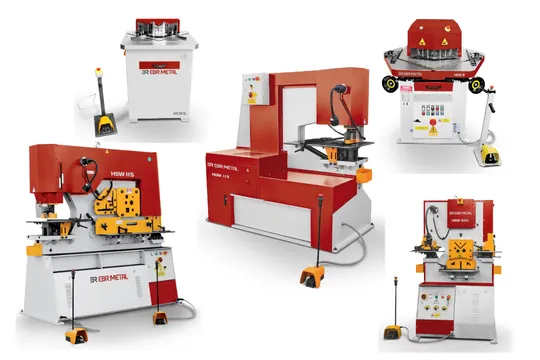
EBR METAL builds three kinds of ironworker and punching machines for steel fabrication:
- the HSW hydraulic ironworker, which punches, shears and notches on one frame;
- the HDM punching machine for holes in plate and flat bar;
- the HCN corner notching machine for sheet metal blanks.
All three are hydraulic, built in Konya and shipped to export customers.
What Is an Ironworker Machine?
An ironworker machine is a hydraulic or mechanical machine with several workstations on one frame: a punch, a flat bar shear, an angle shear, a round and square bar shear and a notcher. The operator moves the material from station to station instead of from machine to machine. In the UK the same machine is often called a steelworker, and in Australia a punch and shear.
Not Every Shop Needs Every Station
Where punching is most of the work, a dedicated punching machine is the simpler choice. Sheet metal shops that prepare blanks for bending often need a corner notcher more than an ironworker.
HSW Hydraulic Ironworkers
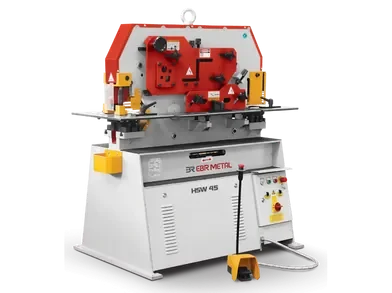
Punching, flat bar, angle and bar shearing and U-notching on one frame. Twin cylinders and two foot pedals on HSW 55, 65, 85, 115 and 175, so two operators can work at once.
40–175 t · 9 models
HDM Hydraulic Punching Machines
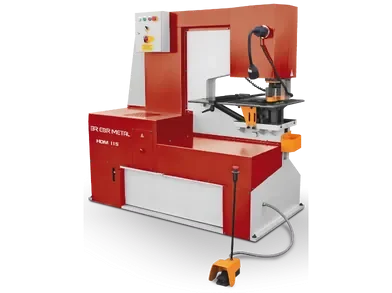
Floor-standing punching machine with a 625 mm throat on HDM 65–175, for holes far from the plate edge. Optional press brake kit.
30–175 t · up to Ø40 × 32 mm
HCN Hydraulic Corner Notching Machines
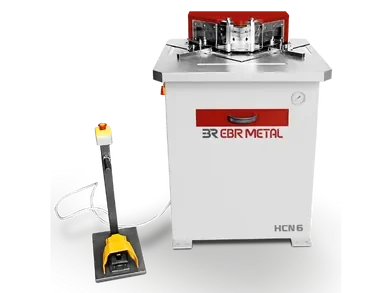
Corner notching for sheet metal blanks. Fixed 90° on HCN 4 and HCN 6; HCN 9 set from 30° to 140°.
Mild steel up to 6 mm
Types and Architectures
- Multi-station ironworker (HSW): one frame with 4 or 5 stations. Single-cylinder models (HSW 40, 45, 60, 65V) for one operator. Twin-cylinder models (HSW 55, 65, 85, 115, 175) with two foot pedals for two operators.
- Dedicated punching machine (HDM): one punching station with a deep throat for hole work. Larger models take a bending kit.
- Corner notching machine (HCN): two blades at a fixed or adjustable angle cut the corner from a sheet blank in one stroke.
Selection Guide
Before you ask for a quotation, have these figures ready:
- the largest hole: diameter and material thickness;
- the largest angle, flat bar and solid round or square bar you cut;
- for sheet work, the thickest blank and the notch angles;
- the material grade (mild or stainless steel);
- how many operators will use the machine at the same time.
Single or Twin Cylinder?
On a twin-cylinder ironworker, each side has its own cylinder and foot pedal, and two people work independently. Stations on both sides of the frame do not by themselves mean two cylinders. On the HSW range, the HSW 55, 65, 85, 115 and 175 are twin-cylinder.
Choosing the Right Machine Type
When Should You Choose an Ironworker?
When the same orders need holes, cut flat bar, cut angle and notches. One HSW does all of this, and the part does not travel across the shop. If two people will need the machine at once, specify a twin-cylinder model from the start.
When Should You Choose a Dedicated Punching Machine?
The HDM suits jobs centred on punching connection plates, base plates and brackets. The HDM 65–175 has a 625 mm throat, deeper than the HSW punching stations up to HSW 115, and it is set up only for punching. Many shops run an HDM next to an ironworker.
When Should You Choose a Corner Notching Machine?
When blanks are notched before bending or welding, as in cabinets, enclosures and duct parts. A fixed 90° HCN needs no angle setting for rectangular parts. The HCN 9 adjusts from 30° to 140° when parts need other angles.
Applications
- Steel construction: connection, gusset and base plates, angle and flat bar parts for bolted structures
- Energy: transmission tower parts, wind tower stairs and platforms
- Agricultural and construction machinery: frames, brackets and flat bar parts
- Trailers and vehicle bodies: hinges, hooks, connecting plates
- Electrical cabinets and enclosures: corner notching and hole punching
- HVAC and ducting, kitchen equipment, metal furniture: corner notching of sheet blanks
- Gates, railings and general fabrication
Materials
Capacities in the catalogues are for mild steel. On the HDM they are given for 450 N/mm² tensile strength. The HCN tables also give stainless steel values, which are lower. Send the material grade and thickness with your enquiry so the model can be sized correctly.
Why EBR METAL
- Experience: 35+ years of team experience in sheet-metal machinery, own production since 2002, EBR METAL brand since 2017.
- Export: machines delivered to 45+ countries on 5 continents.
Quality, Range and Tooling
- Quality: ISO 9001, ISO 14001 and ISO 45001. All machines are built to CE requirements, with hydraulic and electrical components from brands such as Duplomatic, Siemens and Schneider.
- Range: ironworkers, punching machines and corner notchers can be ordered individually or together. For series work, HSW and HDM machines are also built as NC-controlled punching lines.
- Tooling and parts: punches, dies and blades are made by EBR METAL and supplied as spare parts. Punches and dies follow a common industry tooling standard.
Not sure which ironworker machine fits? Send your material grade, thickness and operations, and we will recommend a model.
Let’s Engineer the Right Machine for Your Workshop
Frequently Asked Questions About Ironworker Machines
What is an ironworker machine used for?
For punching holes and cutting flat bar, angle and solid bar, and for notching, all on one machine.
Ironworker or dedicated punching machine?
If the jobs mix punching with cutting and notching, an ironworker saves handling. If most of the work is punching, a punching machine such as the HDM is set up for it, with a deeper throat on the larger models.
What is the difference between a single-cylinder and a twin-cylinder ironworker?
A twin-cylinder machine has two cylinders and two foot pedals, so two operators can work independently. A single-cylinder machine serves one operator at a time.
Is an ironworker the same as a steelworker?
Yes. "Steelworker" is the common name in the UK, and "punch and shear" in Australia.
Can an ironworker notch sheet metal corners?
Its notching station cuts notches in angle and flat bar. For repeatable corner notches in sheet blanks, a corner notching machine such as the HCN is the better tool.
Are spare punches, dies and blades available?
Yes. EBR METAL makes them and supplies them as spare parts for its ironworkers, punching machines and corner notchers.