



Plate Rolling Machines
EBR METAL plate rolling machines, also known as plate bending machines, turn flat sheet and plate into cylinders, cones and curved parts between rotating rolls. The range covers mechanical, motorised and hydraulic 3-roll machines and hydraulic 4-roll machines, from bench-top manual sheet metal rollers up to the largest hydraulic 4-roll models.
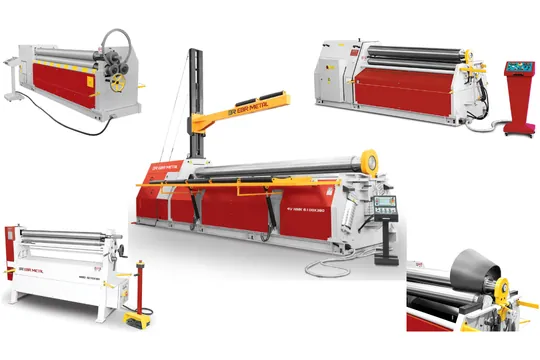
EBR METAL plate rolling machines, also known as plate bending machines, turn flat sheet and plate into cylinders, cones and curved parts between rotating rolls. The range covers mechanical, motorised and hydraulic 3-roll machines and hydraulic 4-roll machines, from bench-top manual sheet metal rollers up to the largest hydraulic 4-roll models.
Rolling Cylinders and Cones from Flat Plate
A sheet metal rolling machine forms the workpiece step by step as it passes between the rolls. That gives a continuous curve. Press brakes and folding machines bend along a straight line. For that work, see Sheet Metal Folding Machines. To bend profiles, see Profile Bending Machines.
Which machine fits depends on the material, the plate size and the inside diameter you need. Pre-bending, the straight end you can accept, how often you run the part and the control level you want also count.
Explore Plate Rolling Machine Types
The range has two families, 3-roll and 4-roll.
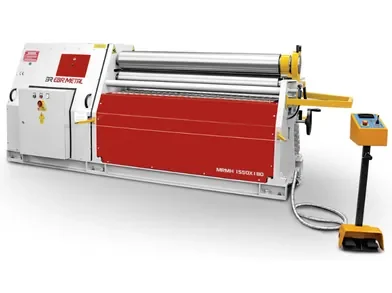
3-Roll Plate Bending Machines
The 3-roll family runs from hydraulic and motorised asymmetrical machines to motorised, manual and bench-top sheet metal rollers.
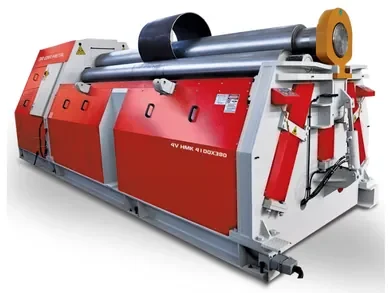
4-Roll Plate Bending Machines
All 4-roll machines are hydraulic. The plate stays clamped between the upper and lower rolls while the side rolls form and pre-bend it. Depending on the model, the rolls move in a pyramidal-linear or an orbital path.
How to Select a Plate Rolling Machine
Many enquiries start with two numbers, such as 10 mm × 3,000 mm. We cannot choose a machine from those two numbers alone. Material, inside diameter, pre-bending and the straight end you can accept all change the answer.
Information We Need
– Thinnest and thickest plate you will roll
– Maximum working length
– Material type and grade
– Required minimum inside diameter
– Whether the stated capacity applies to pre-bending, rolling or both
– Cylindrical or conical part geometry
– Acceptable straight-end allowance
– Production frequency and repeatability
– Preferred control level
– Part handling and support requirements
– Electrical supply at your plant, if it differs from 3-phase 380/400 V
We ask for the thinnest plate as well as the thickest because both are needed to select the machine. We then check the final capacity against your material, working length, inside diameter and pre-bending requirement.
3-Roll or 4-Roll?
Roll count is one factor among several. On a 4-roll machine the plate stays clamped between the upper and lower rolls while the side rolls pre-bend its edges. The hydraulic and mechanical initial-pinch 3-roll machines can also pre-bend. The choice depends on the part geometry, the pre-bending you need, the capacity and your production conditions.
Applications and Materials
Plate rolling machines produce cylindrical and conical parts from flat sheet and plate. The 4-roll machines also roll oval shapes and parts with changing radii.
EBR METAL machines are used for ventilation ducts and fittings, stove pipes, light cylindrical parts, tank and silo shells, pressure-vessel parts, other ducts and machinery bodies.
Capacity and Material Grade
Machine capacities are stated for a reference material, normally a carbon-steel grade. Do not assume the same capacity for stainless steel, aluminium or other alloys. Strength, ductility and springback change the rolling force and the diameter you can reach, so we check capacity for your actual grade.
Conical Parts
Rolling a cone needs a conical bending device and the right cone geometry. Most 3-roll and 4-roll models have the device. Tell us the cone angle, both diameters, thickness and length before choosing a machine.
Controls, Supports and Options
Controls, supports and handling equipment vary with machine size and production method.
NC and CNC Control
NC control is available on the hydraulic 4-roll machines and on the hydraulic and mechanical initial-pinch 3-roll machines. Two 4-roll models are also available with CNC.
The NC control has a teach mode. With teach mode enabled, the operator bends a part while the NC controller records each step. When the saved program is recalled, the machine follows the same bending sequence for the next part.
Support Equipment for Large Diameters
For large diameters, the hydraulic 4-roll machines and the hydraulic 3-roll machine can be fitted with hydraulic lateral side supports and an overhead crane.
Electrical Supply
Electrically powered models are built for a 3-phase, 380/400 V, 50/60 Hz supply as standard. If your plant uses a different supply, tell us when you ask for a quote. We review other options for the specific model and motor power. Not every option is possible on every machine, and on large machines a special transformer can add considerably to the cost.
Machines Built to Order
Besides the standard range, EBR METAL builds machines to order. Examples are custom plate rolling machines for conical work and for bending pre-corrugated sheet, special 3-roll and 4-roll machines, and automatic or semi-automatic systems that take sheet from a feeding table, roll it and send the finished part to a stack. Where the job needs it, the rolls, the machine configuration and the operating mechanism are adapted to the part and the production method. There are no standard capacities or model codes for this work. Send us your part and production details and we will review what is possible.
Discuss Your Plate Rolling Requirements
Send us the material type and grade, the thinnest and thickest plate you will roll, the maximum working length, the required minimum inside diameter and whether the capacity must include pre-bending.
A clear written description of the part is enough. If the forming job is hard to describe, a drawing or a photo of a sample part helps us propose the machine and configuration.
Plate Rolling Machines FAQ
What is the difference between 3-roll and 4-roll plate bending machines?
Both turn flat material into cylindrical or conical parts, with different roll layouts. The 3-roll family includes mechanical, motorised and hydraulic designs. A 4-roll machine is hydraulic: it clamps the plate between the upper and lower rolls while the side rolls pre-bend and form it. The right choice depends on part geometry, material, the straight end you can accept, your production method and the control you need.
Why is pre-bending needed in plate rolling?
Pre-bending shapes the leading and trailing edges of the plate. Without it, a flat section can remain at each end, depending on the diameter. How much of that straight end is removed depends on the machine layout and the plate.
Can plate rolling machines produce conical parts?
Yes, on machines with a conical bending device. The cone you can roll depends on plate size, material, cone angle, both diameters and the machine. Send us the part details before choosing a machine.
Which machines offer NC or CNC control?
NC control is available on the hydraulic 4-roll machines and on the hydraulic and mechanical initial-pinch 3-roll machines. Two 4-roll models are also available with CNC. The NC control has a teach mode: with it enabled, the operator bends a part while the controller records each step, and when the saved program is recalled, the machine follows the same bending sequence for the next part.
What information is required to select a plate rolling machine?
The thinnest and thickest plate you will roll, maximum working length, material type and grade, required minimum inside diameter, and whether the capacity applies to pre-bending, rolling or both. A drawing or photo helps when the part is hard to describe.