



Hydraulic Presses
EBR METAL builds hydraulic presses for deep drawing, forming, straightening, bending and workshop work. Standard models run from 10 to 2,500 tonnes, and custom presses are engineered up to 10,000 tonnes. Every press is configured for the job: frame type, tonnage, stroke, table size, single- or double-action, control and safety equipment.
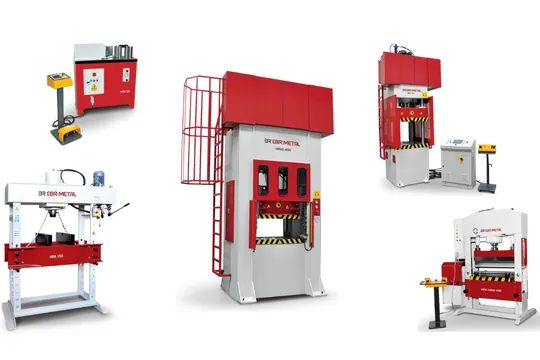
EBR METAL builds hydraulic presses for deep drawing, forming, straightening, bending and workshop work. Standard models run from 10 to 2,500 tonnes, and custom presses are engineered up to 10,000 tonnes.
Every press is configured for the job: frame type, tonnage, stroke, table size, single- or double-action, control and safety equipment.
Hydraulic Presses Overview
The range covers H-frame, 4-column and C-frame production presses, universal and garage-type presses for flexible tooling and bending, straightening presses, workshop presses and horizontal presses. Frames are welded steel and stress-relieved. Precision parts are welded by robot under certified welding procedures.
The larger production models use Bosch Rexroth or Parker hydraulics and Siemens or Schneider electrics. Both hydraulic brands offer international warranty and service in their regions. Available in a CE-conform configuration for CE markets.
Read more...
- Single-, double- and triple-action (with ejector) deep drawing presses
- PLC and touchscreen control on HPHS, HPS and HPC models
- Light curtains, guarding and automation interfaces as options
Types of Hydraulic Presses
Choose by frame, tonnage and the operation the press has to perform.
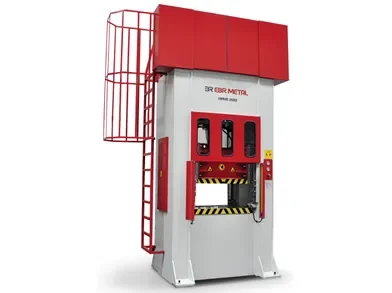
H-Frame Deep Drawing Presses (HPHS)
Solid welded H-frame with an 8-way guided ram for deep drawing and heavy forming. Single-, double- or triple-action, PLC and touchscreen control.
100–2,500 t
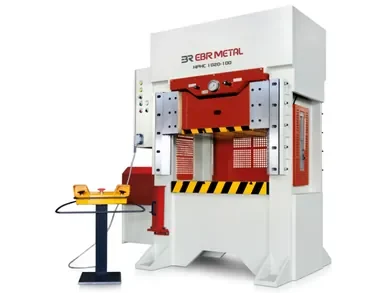
H-Frame Hydraulic Presses (HPHC)
Compact H-frame press with single or double piston, manometer and stepless stroke and pressure setting, for forming and assembly.
100–150 t
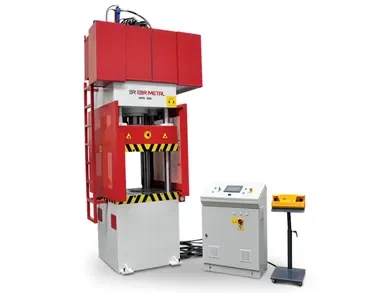
4-Column Deep Drawing Presses (HPS)
Four-column press with a die cushion for deep drawing small and medium parts, with a compact footprint.
40–300 t (to 1,000 t on request)
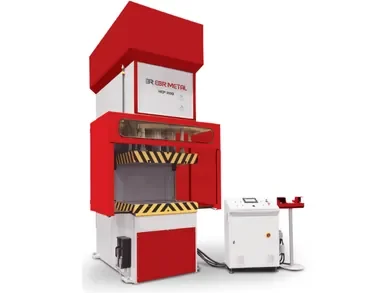
C-Frame Hydraulic Presses (HPC)
Open-front press with access from three sides for forming, assembly and press-fit work, with PLC control.
40–200 t
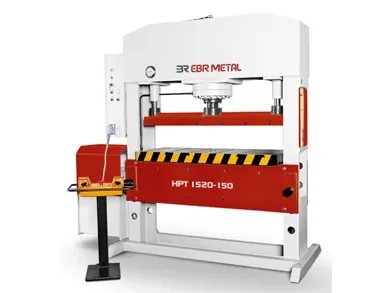
Universal T-Slot Presses (HPT)
Universal frame with an adjustable T-slot bottom table for die setting and forming; bending tooling is optional.
100–150 t
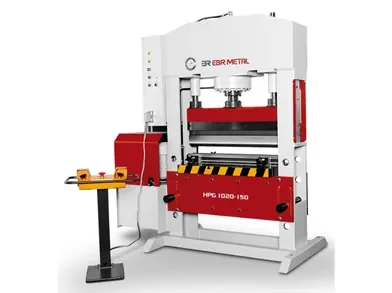
Garage-Type Press Brakes (HPG)
Compact bending press with hardened blades and a five-face prism for sheet bending in small workshops.
100–150 t
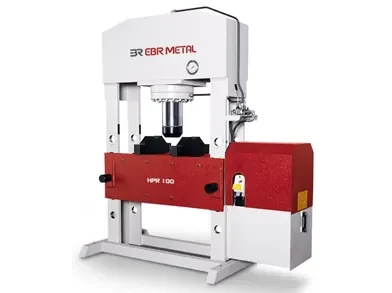
Hydraulic Straightening Presses (HPR)
Straightening of shafts, bars and welded parts on V-blocks, with joystick control and a ram that stops at any point.
30–200 t
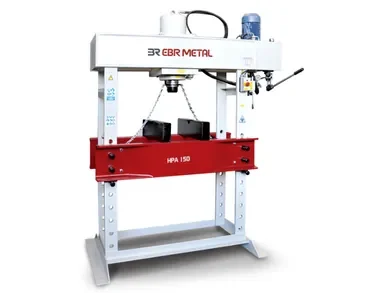
Hydraulic Workshop Presses (HPA)
Motorised workshop press with a height-adjustable work bed and standard hand pump; manual cylinder movement from 30 t; wide HPA-W versions.
10–400 t
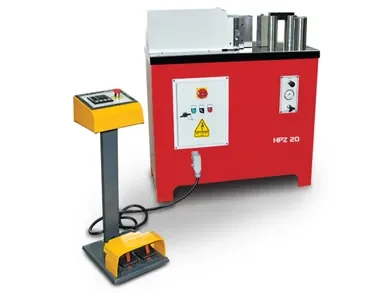
Horizontal Hydraulic Presses (HPZ)
Horizontal press for bending flat bar and tube; punching and straightening tools and NC are optional.
10–100 t
Understanding Hydraulic Press Types
A hydraulic press delivers its full force anywhere in the stroke. How that load is carried, and how the operator gets to the die, comes down to the frame. Stroke, speed and pressure adjustment vary by model and configuration.
Overview
1. H-frame presses (HPHS, HPHC)
Two welded side frames and a guided ram, for large dies and high tonnage.
2. 4-column presses (HPS)
Four guide columns, with the die open from four sides. Used for deep drawing of small and medium parts.
3. C-frame presses (HPC)
Open front for fast part loading and die access from three sides.
4. Universal T-slot presses (HPT)
Adjustable T-slot table for changing dies and bending tools.
5. Garage-type press brakes (HPG)
Short bending press for sheet in workshops. Capacities depend on model and material.
6. Straightening presses (HPR)
For correcting shafts, bars, profiles and welded parts.
7. Workshop presses (HPA)
General pressing, bearing work, assembly and bending with a moving cylinder.
8. Horizontal presses (HPZ)
Horizontal ram for bending and straightening long bars and tubes.
How to Choose the Right Hydraulic Press?
Start from the part: material and thickness, draw depth or bending length, part size and the daily output. Tonnage follows from the ram force, plus the blank-holder force in deep drawing, and the die decides how big the table must be. Tonnage alone does not size a press: daylight, stroke, table size and single- or double-action change the design and the price, so include them in your enquiry.
Quick Selection Guide
Where hydraulic presses excel
Deep drawing of large parts, high tonnage, double-action:
H-frame deep drawing presses (HPHS)
Deep drawing of small and medium parts:
4-column presses (HPS)
Forming and assembly with manual pressure and stroke setting:
H-frame hydraulic presses (HPHC)
Forming and assembly with open access:
C-frame presses (HPC)
Changing dies and bending tools on one press:
Universal T-slot presses (HPT)
Sheet bending in a small workshop:
Garage-type press brakes (HPG)
Straightening shafts, bars and welded parts:
Straightening presses (HPR)
General workshop pressing and maintenance:
Workshop presses (HPA)
Long bars and tubes, horizontal force:
Horizontal presses (HPZ)
Factors to Consider
- Required tonnage
- Stroke length
- Table size and daylight
- Material type and thickness
- Single- or double-action
- Cycle time and production volume
- Safety and guarding requirements
Send us the part details and we will propose the frame, tonnage and options for your production.
Applications of Hydraulic Press Machines
Hydraulic presses form, draw, straighten, bend and assemble parts where controlled force over the full stroke matters.
Use Cases by Industry & Material
Applications
- Deep drawing of sinks, kitchenware, appliance and automotive parts
- Forming and trimming of sheet parts
- Compression molding of composite and SMC parts
- Straightening of shafts, bars and welded structures
- Bending of sheet, flat bar and tube
- Press-fitting, bearing work and assembly
Industries
- Automotive and commercial vehicles
- White goods and kitchen equipment
- Aerospace and the defence industry
- Machine building and steel construction
- Shipbuilding
- Repair and maintenance workshops
Materials
- Carbon steel
- Stainless steel
- Aluminium
- Copper and brass
- Composites and SMC
Typical Part Characteristics (guide)
- Sheet thickness and draw depth set the ram and blank-holder force.
- Large dies and off-centre loads need a rigid H-frame with a guided ram.
- Small and medium drawn parts suit 4-column presses.
- Long bars and tubes suit horizontal presses.
Custom and Special-Purpose Presses
Beyond the standard range, EBR METAL designs presses for a single process or production line, up to 10,000 tonnes. Large frames are checked by finite-element analysis before manufacture. We can build:
- compression molding and SMC composite presses, with hydraulic motion control (HMC) for precise positioning and ram parallelism
- servo-hydraulic and hybrid presses, and presses with heated platens
- hydroforming presses, which form the sheet against a single die with fluid pressure
- upstroke presses and long-stroke drawing presses
- explosion-proof (Ex) presses, with components selected for the customer’s zone classification in line with European ATEX requirements
- presses for the defence industry: ballistic composite panels, hot forging of hollow steel parts and shell-case production lines
Why Choose EBR METAL Hydraulic Presses?
Our team brings more than 35 years of sheet-metal machinery experience. Own production started in 2002, and presses have carried the EBR METAL brand since 2017. They are exported to more than 45 countries across 5 continents: Europe, the Middle East, Africa, North America, Central Asia, Southeast Asia and Australia. One example is a deep drawing press project delivered to Australia. Standard presses and project presses are designed, welded, machined and assembled in our own plant, under ISO 9001, ISO 14001 and ISO 45001 certified management systems.
Why EBR METAL?
Engineering & Control
- Frame chosen for the application
- Proportional pressure and speed control available as an option on HPHS and HPS
- Parallelism to ISO and DIN tolerances
- Finite-element analysis on large frames
Product Range
- H-frame, 4-column and C-frame presses
- Universal, garage-type, straightening, workshop and horizontal presses
- Custom presses up to 10,000 tonnes
Build
- Stress-relieved welded steel frames
- Certified welding, robotic welding for precision parts
- Large frames machined on 5-axis CNC
Support
- Bosch Rexroth or Parker hydraulics with international service networks
- Remote connection to presses with PLC and remote-control capability
- On-site commissioning and operator training
- Tooling and die support on request
For high-speed blanking and stamping, see our mechanical (eccentric) presses.
Ready to Size Your Hydraulic Press?
Send us the material, part size and the force you need. We will recommend the press type and configuration.
Custom production • Global shipping • Engineering support
Frequently Asked Questions
How do I choose the right hydraulic press?
Start with the operation, the material and thickness, the part size and the required force. Deep drawing, straightening, bending and assembly call for different frames. Send us a drawing and we will propose a model.
How much tonnage do I need?
It depends on material grade, thickness, part geometry and, in deep drawing, the draw depth. Drawing needs both ram force and blank-holder force. We calculate it from your part drawing.
What is the difference between H-frame and 4-column hydraulic presses?
An H-frame press has two welded side frames, with a guided ram in a rigid welded frame, suited to large dies and high tonnage. A 4-column press gives access to the die from four sides and suits deep drawing of small and medium parts.
Single-action or double-action press for deep drawing?
A double-action press has a die cushion that holds the blank while the ram draws the part, which helps prevent wrinkling. Single-action presses suit forming and shallow drawing. Either can have an ejector. A double-action press with an ejector is known as triple-action.
Hydraulic or mechanical press?
For fast, repetitive blanking and stamping, a mechanical press is the usual pick. Hydraulic presses give full force over the whole stroke, which suits deep drawing, forming and thicker material. Stroke, speed and pressure adjustment depend on the model and configuration.
Can a hydraulic press be automated?
Yes. Presses can be built with light curtains, safety guarding, part feeding and interfaces to automation equipment.
Which hydraulic and electrical components do you use?
The production presses use Bosch Rexroth or Parker hydraulics and Siemens or Schneider electrics. HAWE is also used. Smaller models use Italian hydraulic components (Duplomatic). Rexroth and Parker provide international warranty and service for the hydraulic system.
What is the lead time?
It depends on the model and the level of customisation. We confirm it once the technical details are final, and machines are packed for export.