



3-Roll Plate Bending Machines
EBR METAL 3-roll plate bending machines roll sheet and plate into cylinders and, on models with a conical bending device, into cones. The range runs from hydraulic and mechanical initial-pinch machines to motorised and manual rollers and a bench-top manual roller.
EBR METAL provides a full range of 3-roll plate rolling machines, including mechanical, hydraulic and motorised configurations.
Types of 3-Roll Plate Bending Machines
3-roll plate bending machines differ in roll layout, drive and frame. In the EBR METAL range, the hydraulic MRMH and the mechanical MRMS are asymmetrical initial-pinch machines, and the MRM is an asymmetrical machine with a cast-iron frame. The other groups are motorised or manual mechanical 3-roll plate bending machines with cast-iron frames.
Asymmetrical (Initial Pinch)
The plate is gripped between the top and bottom rolls while the back roll bends it. Because the plate is held from the start, MRMH and MRMS can pre-bend the plate edge.
Mechanical and Motorised Drive
MRMS is driven through a planetary reducer and adjusts its back roll by motor. MRM, MRD and MSR drive the top and bottom rolls through a single gearbox. RD and SR are hand-operated versions of MRD and MSR.
Hydraulic Roll Positioning
On the MRMH, the back and bottom rolls move hydraulically, and the top roll is released by a hydraulic drop-end. A planetary gearbox drives the top and bottom rolls.
Cone Rolling
Cones are rolled with a conical bending device. It is standard on the MRMH, MRMS, MRM, MRD and RD.
| Machine | Frame | Drive | Drop-end | Conical bending device | NC control |
|---|---|---|---|---|---|
| MRMH | Welded steel | Motor and planetary gearbox; hydraulic roll positioning | Hydraulic | Standard | Optional |
| MRMS | Welded steel | Motor and planetary reducer; motorised back roll | Manual | Standard | Optional |
| MRM | Spheroid cast iron | Motor and single gearbox | Manual | Standard | — |
| MRD | RD | Cast iron | MRD motorised, RD manual | Manual | Standard | — |
| MSR | SR | Cast iron | MSR motorised, SR manual | Manual | — | — |
| MR | Cast iron | Manual, bench-top | Swing-out top roll | — | — |
Explore All 3-Roll Plate Bending Machines
Capacities, roll sizes and options vary by model. Compare the six groups below.
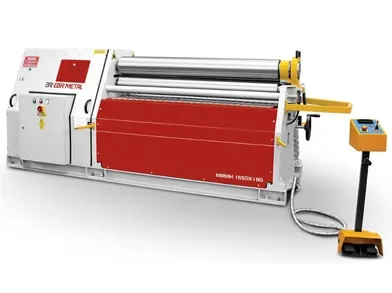
Hydraulic 3-Roll Plate Bending Machine
MRMH (3-Roll)
Hydraulic initial-pinch machine with welded steel frames, hydraulic back and bottom roll positioning and a hydraulic drop-end. It can pre-bend the plate edge, and a conical bending device is standard.
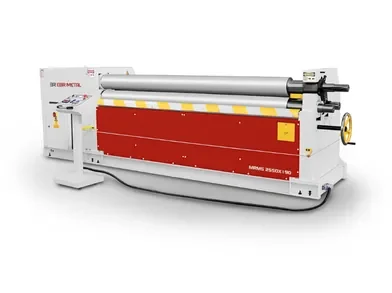
Mechanical 3-Roll Plate Bending Machine
MRMS (3-Roll)
Initial-pinch machine with welded steel frames, a planetary reducer drive and a motorised back roll. A conical bending device is standard.
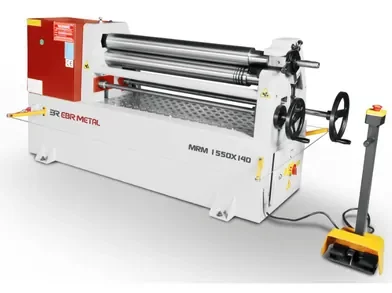
Asymmetrical 3-Roll Plate Bending Machine
MRM (3-Roll)
Asymmetrical machine with spheroid cast-iron frames, a single-gearbox roll drive and a mobile foot-pedal control panel.
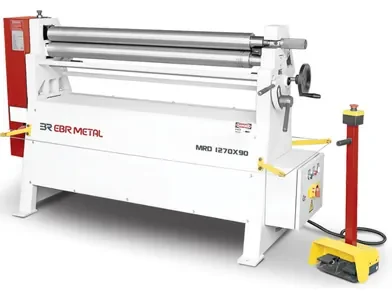
MRD | RD Motorised & Manual Plate Roller (3-Roll)
Cast-iron machines with a motor drive (MRD) or for manual operation (RD), rolling from 3.0 mm on the shortest model to 1.5 mm on the longest.
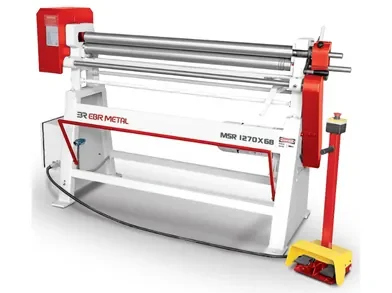
MSR | SR Motorised & Manual Plate Roller (3-Roll)
Cast-iron machines for sheet from 0.8 to 2.0 mm, with a motor drive (MSR) or for manual operation (SR).
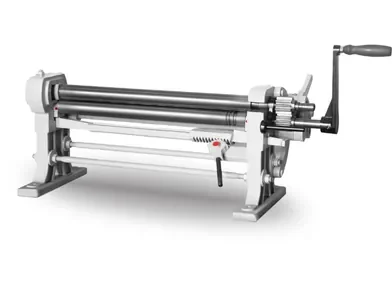
MR Manual Bench-Top Sheet Metal Roller (3-Roll)
Hand-operated bench-top roller for sheet from 0.6 to 1.2 mm, with no stand and no motor.
Applications & Materials
Depending on the model, its equipment and its capacity, these machines roll cylinders and parts with different diameters, and cones on models with a conical bending device. The right model depends on the material, the thickness, the working length and the diameter.
Typical Applications
- Ventilation ducts and fittings
- Stove pipes
- Light cylindrical parts
- Machinery bodies
- Tank and silo shells, on the MRMH or MRMS, or on higher-capacity 3-roll machines built to order
- Cones, on models with a conical bending device
Materials & Gauges
- Carbon steel: capacities are stated for a reference carbon-steel grade
- Stainless steel: allow a lower capacity than for carbon steel
- Aluminium and non-ferrous sheet: expect higher springback
- Shorter working lengths take thicker material; longer lengths reduce it
- For aluminium composite panels, the MRMS can be fitted with an optional plastic-coated top roll
- Exact capacity depends on the material and the model. Ask us for the capacity of the model you are considering.
Selection Basics
Send us the material and grade, the thinnest and thickest sheet, the working length and the minimum inside diameter. Tell us whether you need pre-bending or cones. The minimum inside diameter depends mainly on the top roll diameter, the material and the thickness. We calculate it for your part. For dedicated profile and pipe work, see Profile Bending Machines. The MRMS can also take an optional profile and section bending roll set.
Controls and Large-Diameter Support
NC control is available on the MRMH and the MRMS. The NC control has a teach mode: the operator bends a part while the controller records each step, and the saved program repeats the same sequence on the next part. For large diameters, the MRMH can be fitted with hydraulic lateral side supports and an overhead crane.
3-Roll Machines Built to Order
Besides the six standard groups, EBR METAL builds special 3-roll machines to order. Where the part needs it, the rolls, the machine configuration and the operating mechanism are adapted. There are no standard capacities or model codes for this work. Send us your part and production details and we will review what is possible.
Looking for the right 3-roll plate bending machine for your production?
Tell us what you need to roll. A drawing or a photo of a sample part helps us propose a model and configuration.
Frequently Asked Questions — 3-Roll Plate Bending Machines
What is a 3-roll asymmetrical (initial-pinch) plate roller?
The plate is gripped between the top and bottom rolls while the back roll bends it, so the machine can pre-bend the plate edge. In the EBR METAL range, MRMH and MRMS are initial-pinch machines, and MRM is an asymmetrical machine with a cast-iron frame.
3-roll vs 4-roll: when should I choose a 3-roll machine?
It depends on the part geometry, the pre-bending you need, the capacity and your production conditions. On a 4-roll machine, the plate stays clamped between the upper and lower rolls while the side rolls pre-bend its edges. See 4-Roll Plate Bending Machines and Plate Rolling Machines.
What is the minimum/maximum diameter on a 3-roll plate roller?
The minimum inside diameter depends mainly on the top roll diameter, the material and the thickness. The maximum diameter depends on the working length and the part, and support equipment may be needed for large diameters. We calculate both for your part when we prepare the quotation.
Which 3-roll machines can pre-bend the plate ends?
The initial-pinch machines, MRMH and MRMS, have a pre-bending capacity in their tables. How much straight end remains depends on the plate and the diameter.
Can a 3-roll roller form cones and tapered parts?
Yes. A conical bending device is standard on the MRMH, MRMS, MRM, MRD and RD. Tell us the cone angle, both diameters, the thickness and the length.
Which drive and control options are available?
Hydraulic (MRMH), motorised mechanical (MRMS, MRM, MRD, MSR) and manual (RD, SR, MR). NC control is available on the MRMH and the MRMS. CNC control is not listed for the standard 3-roll models; for machines built to order, ask us.