



Profile Bending Machines (Angle Rolls)
Hydraulic and motorized machines that roll tube, pipe, angle, flat bar and structural sections into curves and full rings.
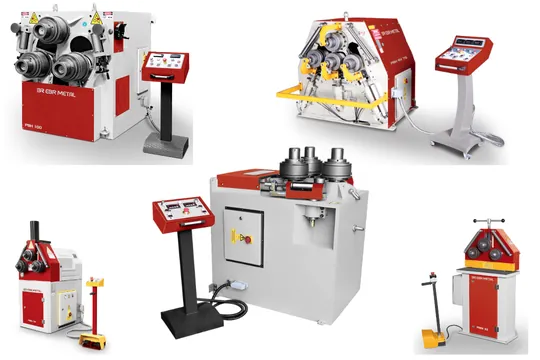
Hydraulic and motorized machines that roll tube, pipe, angle, flat bar and structural sections into curves and full rings.
Profile Bending Machines for Tube, Pipe and Sections
A profile bending machine forms long sections into arcs, rings and spirals by passing them between driven rolls. EBR METAL builds three ranges: PBH hydraulic angle rolls with three driven rolls, PBH 4V four-roll machines, and the compact PBM motorized range. In the UK the same machine is often called a section bender, and in Australia a section roller or a section and pipe rolling machine.
Read more...
All models work in both the horizontal and the vertical position and come with a standard set of rolls. Rolls for pipe, tube and special profiles are available as options. Capacities run from small flat bar and tube on the PBM 32 up to HEA 140 and HEB 120 beams on the PBH 120. Each machine can be adapted to the capacity the customer needs.
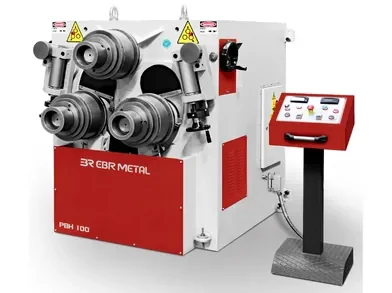
PBH Hydraulic Angle Rolls
Three driven rolls, positioned hydraulically. Seven sizes from PBH 40 to PBH 120, for tube, pipe, angle, flat bar and beams.
PBH 40 to PBH 120 · 7 models
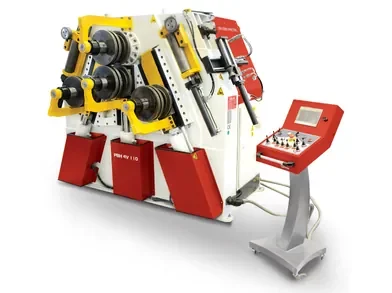
PBH 4V 4-Roll Profile Bending Machines
Four rolls, with hydraulic bottom and side rolls. Pre-bending without turning the part around.
Shafts Ø70–110 mm · 3 models
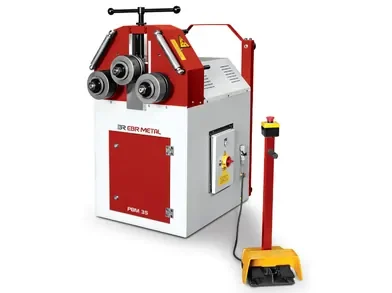
PBM Motorized Profile Bending Machines
Two gear-driven bottom rolls and an idle top roll; hydraulic top roll on the PBM 45. For lighter tube, flat bar and angle work.
Shafts Ø30–50 mm · 3 models
What Is Section Bending?
Section bending, also called profile bending or angle rolling, curves a long part by feeding it back and forth between three or four rolls while the forming roll is moved in step by step. The bend builds up gradually over successive passes. A section bending machine produces large radii, full rings and spirals.
Read more...
Shaped rolls hold the section during bending. Tube and pipe need grooved rolls that match the diameter; angle, channel and T-sections are bent with the leg facing in or out, and flat bar on its face or on edge. The machine’s capacity chart lists, for each profile and orientation, the largest section and the smallest bending diameter.
3-Roll or 4-Roll?
- 3-roll (PBH, PBM): the part runs over two bottom rolls while the top roll forms the bend. The part ends stay straight for a short length and are usually trimmed or pre-bent separately.
- 4-roll (PBH 4V): the extra rolls clamp and guide the part, so the operator can pre-bend both ends and roll the curve without taking the part out. This saves handling on repeated work.
- Drive: PBH and PBH 4V are hydraulic machines with motor-driven rolls; PBM uses a gear-driven pair of bottom rolls and is the compact choice for lighter sections.
Applications
- Steel structures and architecture: curved beams for roofs, domes, canopies and pergolas
- Stairs and railings: spiral and curved stair stringers, handrails, balusters
- Pipe work: pipe flanges, rings and tube spirals
- Greenhouses and agricultural structures: arched frames from tube and profile
- Gates, doors, windows and fences
- Metal furniture: chairs, tables and frames
- Urban furniture: lamp posts, bollards, bicycle stands, tree guards, playground equipment
Materials
The machines bend mild steel, stainless steel, aluminium, copper, brass and galvanized pipe. Catalogue capacities are given for 260 N/mm² yield strength. For higher-strength materials or thin-walled tube, include the grade, section dimensions and required radius in your enquiry. For aluminium and stainless steel, PBH 50 and 60 can be fitted with Delrin (plastic) rolls.
Why EBR METAL
- Experience: 35+ years of team experience in sheet-metal machinery, own production since 2002, EBR METAL brand since 2017.
- Export: machines delivered to 45+ countries on 5 continents.
- Quality: ISO 9001, ISO 14001 and ISO 45001; built to CE requirements.
- Proven capacities: the capacity charts come from many years of production experience and engineering calculation, and the machines have been built to the same standard for years.
- Tested before shipment: every machine passes a bending test. On request, we film the test with your own material.
- Clean bends: customers most often mention that the sections come off the machine without deformation.
- Components: hydraulic and electrical components from brands such as Siemens, Schneider and Duplomatic.
- Rolls for your parts: custom rolls for special profiles and bends are available as an option.
- Support: free video-call support; on-site installation and training for larger machines at extra cost. 1-year warranty, and spare parts are kept in stock.
Ready to Upgrade Your Bending Productivity?
For each part, send the material, the section type and size, the wall thickness and the smallest inside diameter you need. We will recommend the right machine and roll set.
Frequently Asked Questions About Profile Bending Machines
What is a profile bending machine used for?
For rolling tube, pipe, flat bar, angle, channel and beams into curves, rings and spirals: stair stringers, railings, arches, flanges and frames.
Is a section roller the same as a profile bending machine?
Yes. Profile bending machine, angle roll, section bender and section roller are names for the same type of machine. The term changes by country.
Can a profile bending machine bend pipe?
Yes, with grooved pipe rolls, which are optional on EBR METAL machines. It rolls pipe into large radii and rings. Tight elbows, such as 90° bends close to the die, are made on a rotary draw bender instead.
Should I choose 3 rolls or 4 rolls?
Choose from the section size, required radius and end requirements. The PBH 4V can pre-bend both ends without removing and turning the part.
Can one set of rolls bend all my pipes?
No. Each pipe or tube outside diameter needs its own set of grooved rolls. List every tube size you bend, with its wall thickness, so the right roll sets are quoted with the machine.
How long does delivery take?
Standard machines are supplied with short lead times. We confirm the delivery date with the quotation.
What warranty and support do you provide?
A 1-year warranty, spare parts from stock and free support by video call. For larger machines, our team can install the machine and train your operators on site, at extra cost.